The Fleet Idling Bill Fleet Managers Can’t See and Why Bad Hardware Integration Makes It Worse
Fuel costs can account for up to 40% of your fleet’s total cost of ownership, yet one of the biggest drains on that budget is happening when your vehicles aren’t even moving. Idling quietly burns through fuel, accelerates engine wear, and contributes to emissions that are increasingly under regulatory scrutiny. In this post, we break down the real cost of idling, why it’s so easy to overlook, and how the right telematics setup, professionally installed across your fleet, gives you the data and alerts to tackle it head-on.

Fuel is one of the biggest operating expenses for businesses that run commercial vehicles, with some sources quoting that it can easily add up to 25% to 40% of the total cost of ownership of the vehicles. Yet one of the biggest drains on that budget is happening when your vehicles aren’t even moving. Idling quietly burns through fuel, accelerates engine wear, and contributes to emissions that are increasingly under regulatory scrutiny. In this post, we break down the real cost of idling, why it’s so easy to overlook, and how properly integrated telematics gives you the data you need to tackle it.
In this article, we will discuss the silent fuel cost driver – vehicle idling. For clarity, this article is focused on internal‑ combustion vehicles. Fully electric vehicles do not “idle” in the same way, as there is no engine running when they are stationary.
What is idling?
Idling is when the vehicle engine is left running while the vehicle is stationary, for example at traffic lights or during pick‑ups. Some idling is unavoidable, but if the engine is left running when the vehicle is not being driven, examined, or used to operate machinery such as a lift or crane for more than a short period, this is considered unnecessary or excessive idling.
Modern vehicles have gone some way towards addressing this through start-stop technology and mild hybrid systems, though these can be switched off by the driver and do not account for vehicles being left running unattended altogether.

Telematics
Fleet telematics installation company for operators, fleet management companies and telematics suppliers.…
See how we install itWhat’s the problem with idling?
Leaving a vehicle’s engine running when it is not moving has a direct impact on the amount of fuel the vehicle will use. This excessive idling wastes a lot of fuel, leading to high fuel expenditure. Guidance from industry bodies like FORS indicates that car idling can account for up to around 8% of total fuel use in some operations, and that cutting unnecessary idling can typically deliver fuel savings in the region of 1% to 5%.
Now, you may think this is a small cost. But in our context, we deal with commercial vehicles. For heavy commercial vehicles, unnecessary idling for an hour can waste around 2.3 litres or more of fuel; across a large fleet, this quickly becomes material. So imagine, if a fleet of 100 heavy vehicles each wastes roughly 2.3 litres per day through avoidable idling, that is over 200 litres of fuel lost every day.
FORS and TfL back this up by saying that, depending on the nature of the operation and vehicle types, fleet operators can expect average fuel savings in the region of 1% to 5% when implementing truck anti-idling measures.
Idling does two things
Excessive idling does not stop at fuel consumption. Its effects spread across several areas of fleet performance and risk, each carrying its own financial and operational consequences. The two biggest are:
Fuel cost
Engine idling directly affects fuel costs, if your vehicles are constantly idling daily, this is gallons of potential fuel that could be used for jobs that are simply going to waste. Miles per gallon are affected, which reduces operational efficiency, inflating fleet cost per job or cost per route.
Environmental impact
Excessive idling is not good for the environment because you are using more fuel. But you would be mistaken for thinking this is the only issue, unnecessary idling increases fuel consumption, which in turn increases emissions and degrades air quality. For fleets required to monitor and report on their environmental performance as part of a wider business sustainability strategy, excessive idling works directly against those targets. Beyond the commercial implications, poor air quality driven by vehicle emissions has well-documented health consequences, disproportionately affecting the elderly, young children, and those with pre-existing respiratory conditions such as asthma.
Maintenance
Key vehicle engine components such as spark plugs, the exhaust system, and the engine itself are significantly affected when vehicles are left to idle. This can lead to poor miles per gallon, corrosion, and oil contamination affecting engine cylinders and piston rings.
Over time, this can result in vehicle downtime, costly repairs, and even replacing vehicles sooner than you need to.
Fines
In some cases where excessive vehicle idling occurs, your drivers may risk fines, which adds to operational costs. Legally, unnecessary idling is an offence under Regulation 98 of the Road Vehicle Regulations (1986) and Section 42 of the Road Traffic Act (1988). The fines depend on location, typically £20, increasing to £40 if not paid within 28 days. In some London areas, fines can reach £80.
Increased risk
Vehicle idling exposes your business to additional risk. Depending on the type of idling involved, your business could be vulnerable. One of the most common forms of idling happens during winter when drivers de-ice their vehicles before driving. They may leave keys in the ignition while running the air conditioning or heating, which exposes the vehicle to theft.
For transport, logistics and last-mile delivery fleets, drivers may also leave vehicles idling as they drop off packages. If the vehicle is stolen in these circumstances, it could leave both the driver and the business liable for the theft, with thousands of pounds worth of equipment, stock, and brand reputation at risk. In the United Kingdom, it’s increasingly common to see police notices warning about the dangers of leaving vehicles idling, especially when de-icing the windscreen on cold mornings, which underlines just how serious the risk is when commercial vehicles are left unattended.
The consequences do not stop at fuel wastage and increased maintenance costs. Stolen vehicles are a big risk to businesses as they are often used to commit further crimes, such as additional vehicle thefts, burglary, or dangerous driving offences like speeding. There is also growing awareness in the industry that commercial vehicles can be targeted for use as weapons in terrorist attacks, which is why there is official guidance and training focused on preventing vehicles from being stolen and used in this manner. This just shows why idling should be reduced.
How to reduce idling
Driver behaviour is central to the idling problem, which means education is a core part of the solution. There are many myths surrounding vehicles that affect driver behaviour, for example, one widely held belief among drivers is that it is more efficient to leave the engine running than to switch it off and restart after a short stop, on the basis that restarting uses more fuel. However, research consistently shows the opposite – switching off and restarting after a minute produces less pollution and uses less fuel than leaving the engine running. So even if you are running a delivery route and stopping for a minute, it is more environmentally friendly to switch off the engine. Communicating this type of information clearly to drivers, and reinforcing it as part of your fleet safety culture, can make a material difference.
Telematics
Telematics technology exists to help fleet operators tackle excessive vehicle idling. Reporting tools can log how much idling occurs, allowing you to identify trends such as which vehicle types are idling the most, which sites are most affected, and whether the issue is related to over-resourcing, poor scheduling, or optimisation challenges.
With the right data, fleet operators can take informed action. Industry publications such as Fleet Maintenance show that telematics can reduce idling by up to 40%, presenting significant cost savings and environmental benefits for fleet operators.
However, capturing accurate idling data is not always straightforward. A vehicle may appear to be idling but is it stuck in traffic? Is it operating auxiliary equipment? Is it powering a crane or lift? Without proper integration, the data can lack context.
Installation & Hardware Integration – Where We Add Value
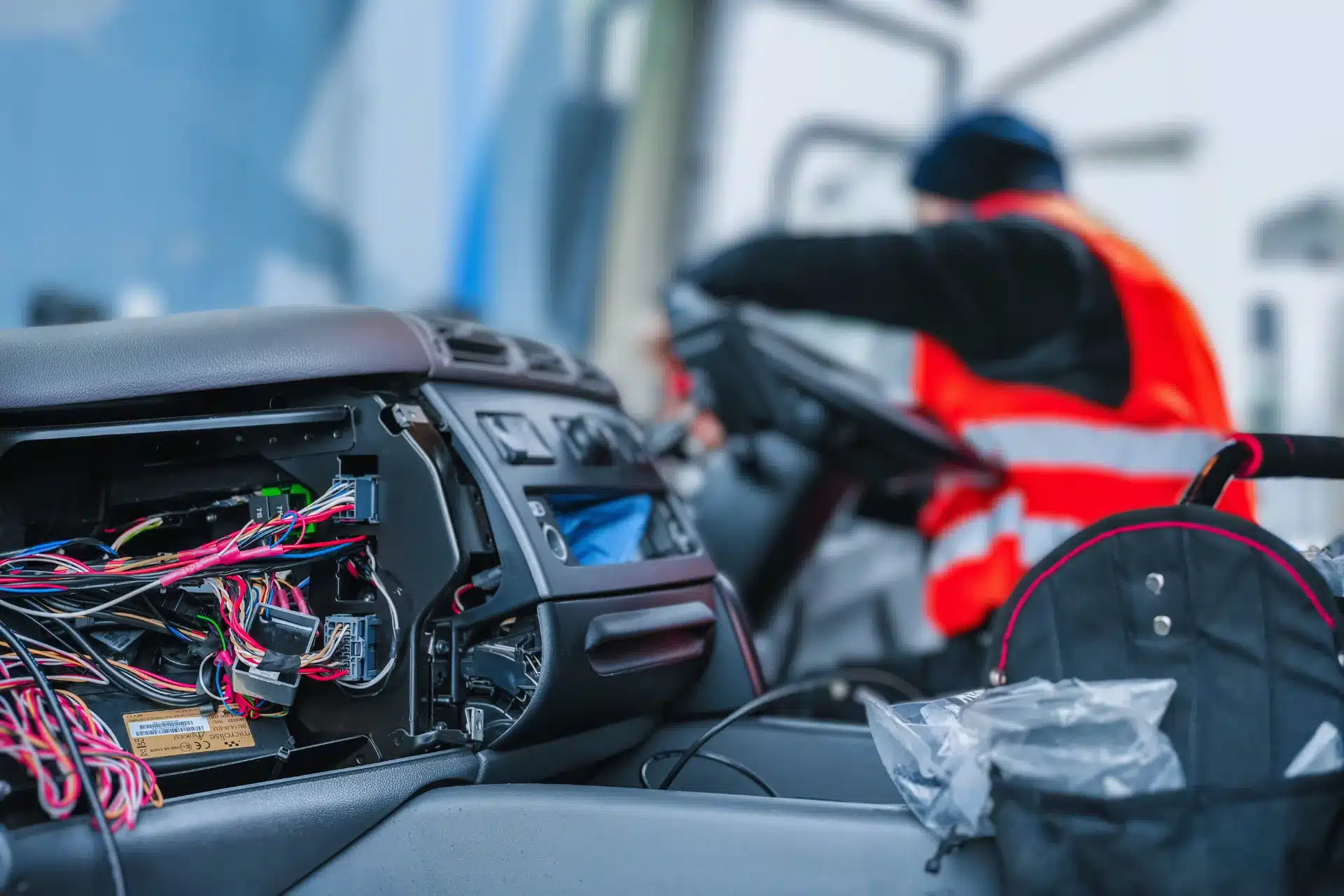
Whilst we do not provide anti-idling software or telematics platforms directly, we support fleet operators and telematics providers with the part of the process that determines whether those systems actually work: the hardware installation and integration.
Accurately tracking idling in a complex commercial vehicle environment requires more than fitting a black box. Engines on commercial vehicles are frequently left running for entirely legitimate operational reasons like to power auxiliary equipment such as cranes, tail lifts, refrigeration units, or other specialist systems. Without proper integration and communication between the telematics device and those additional systems, the platform cannot distinguish between operational engine use and genuine unnecessary idling. The result is inaccurate reporting, and fleet managers making decisions based on data that does not reflect what is actually happening on the ground.
We provide custom installation solutions that integrate telematics systems with auxiliary equipment on the vehicle. By connecting to additional systems, we help ensure fleet operators can differentiate between:
- Engine use for operational tasks
- Genuine excessive idling
- Traffic-related stationary time
This level of integration improves the accuracy of reporting, supports better decision-making, and helps fleet operators avoid acting on misleading data. For telematics providers, we act as the installation partner that ensures their technology works effectively within complex commercial vehicle environments.
So whilst we do not offer a direct anti-idling product, we enable the technology that does ensuring it is installed, integrated, and functioning correctly in real-world fleet operations.
Contact Us
This highlights the importance of driver education and challenges common myths around vehicle idling. It also shows how telematics can help fleets monitor and reduce idling, while emphasising that accurate reporting depends on proper hardware integration, particularly where vehicles operate auxiliary equipment.
For practical support with telematics installation and hardware integration to help reduce excessive idling, speak to our team today.

Written by
James Pearson
James Pearson is the Field Operations Manager at Nationwide Fleet Installations, a trusted vehicle technology installation provider headquartered in the North West and operating across the UK. With a career that began as an auto electrical engineer, James brings over 15 years of hands-on experience to the role, specialising in the installation of cameras, sensors, trackers, and IoT solutions for fleets. He helps fleet operators and vehicle technology providers ensure their technology is professionally installed to the highest standards. Having progressed in the industry through roles such as field technician, to Area Manager and Quality Assurance Manager, James is known for his leadership skills and commitment to developing talent. His colleagues often praise his ability to mentor and coach, helping team members learn and grow on the job.
Telematics
Fleet telematics installation company for operators, fleet management companies and telematics suppliers.…
See how we install itGet In Touch
We provide fleet operators and equipment providers alike with a nationwide installation service for telematics equipment, safety systems, and more. Call us on 0161 786 6600 or email the team at info@nationwidefleetinstallations.com to see what we can do for you.